
TAHAMÍ GEOPARK PROJECT
Geology · Culture · Community
1.5 billion years of history in the Central Mountain Range of Colombia

THE TAHAMÍ GEOPARK PROJECT
Always in search of inspiration
GEOLOGICAL AND CULTURAL HERITAGE OF THE DEPARTMENT OF ANTIOQUIA.
This ambitious project promotes the creation of a geopark in the northern part of the Andes, in the Central Mountain Range of Colombia, in the department of Antioquia.
An area where the forces of three tectonic plates converge: the Caribbean and Nazca oceanic plates and the South American continental plate, which constitutes one of the most fascinating features of Colombian geology.

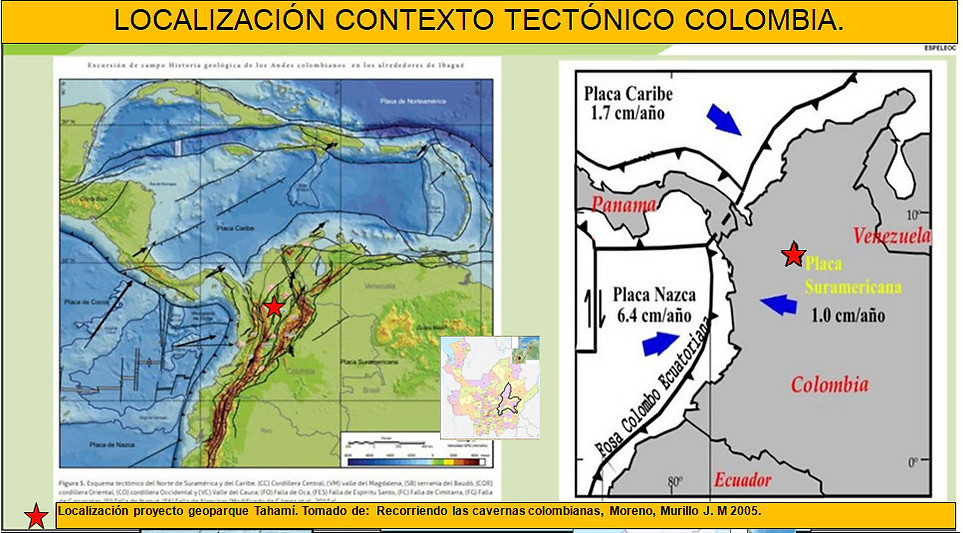


In this geopark, the first in Antioquia, the way in which geology and the population are intertwined will be shown and highlighted.
The presence of numerous gold and silver mineralizations, related to the Antioquia Batholith, attracted populations from pre-Hispanic times, as demonstrated by the petroglyphs created by the Tahamíes and the countless stories of tombs with indigenous treasures, although they were not the only tribe present, they left indelible marks.


We recognize that the path to creating this geopark will be a gradual process, but we are convinced that with the active participation of the entire local community and the support of departmental and local authorities, we will achieve our goal. Together, we are committed to working tirelessly to make this shared dream a reality and ensure sustainable and harmonious development for our region.
The project was submitted in April 2024 to the Colombian Geological Survey, which is legally responsible in Colombia for receiving proposals for future Geoparks. It has also been sent to the board of directors of the Latin American and Caribbean Geoparks Network (GEOLAC) for their support.
We have the support of a geology research group from the National University of Medellín, led by Professor Luis Hernán Sánchez Arredondo, Albeiro Rendón, and Adiela Martinez. We also have the support of the Colombian Geological Society, Antioquia chapter, led by Mariana Vásquez.
Por qué se llama Proyecto Geoparque Tahamí?
El Proyecto Geoparque Tahamí recibe este nombre por la estrecha relación entre la historia geológica y la memoria cultural del territorio.
Desde el punto de vista cultural, el nombre rinde homenaje a la tribu indigena tahamí que habitó amplias zonas de Antioquia antes de la llegada de los españoles y dejaron una huella importante en la historia y la identidad de sus comunidades.
Desde el punto de vista geológico, hace referencia al Terreno Tahamí, una unidad tectonoestratigráfica reconocida en la Cordillera Central de Colombia, Restrepo, (J. J., & Toussaint, J. F, 2020). conformada principalmente por rocas metamórficas antiguas y posteriormente afectada por diferentes acontecimientos tectónicos y magmáticos.
El nombre Tahamí simboliza, por tanto, la unión entre la historia de la Tierra y la historia de las comunidades. No significa que todo el territorio del proyecto pertenezca exclusivamente al Terreno Tahamí, pues también comprende otras unidades y dominios geológicos que enriquecen su geodiversidad.

THE TAHAMIES
The Tahamíes, an indigenous group from Colombia belonging to the Chibchan language family, inhabited the eastern region of the Department of Antioquia, between the Magdalena River to the east and the Porce and Nechí Rivers to the west. Their territory encompassed the present-day municipalities of Medellín, El Retiro, El Carmen de Viboral, Rionegro, Remedios, Marinilla, Segovia, Amalfi, El Peñol, La Ceja, Puerto Nare, Guarne, La Pintada, Cisneros, Yalí, Yolombó, Zaragoza, Vegachí, and Maceo.
The Spanish ventured into Tahamí territories in the second half of the 16th century in search of gold and river routes connecting the Cauca, Porce, and Nechí rivers with the Magdalena. This led to cultural subjugation and intermingling with the Spanish and with Africans, especially those from West Africa, brought by the former as slaves to extract gold and replace the indigenous population. The invasion resulted in the loss of the language, many customs, and the imposition of the Catholic religion, which, however, could not eliminate many local beliefs associated with the worship of the jungle and the jaguar.
